
Curriculum

Our goal is to create a positive, secure environment that encourages children to become enthusiastic, lifelong learners and self-confident, caring adults.
We follow the open and flexible framework of the Creative Curriculum and integrate key elements of other well-known curricula, including Reggio Emilia, Waldorf, and Montessori, to create a play-based curriculum that focuses on the total development of the child, including cognitive, social, emotional, and physical skills and language and communication.

Our Six Guiding Principles
These Guiding Principles represent a prioritized summary of the most important tenets in our curricula. These principles incorporate elements from several early childhood education curricula, including Creative Curriculum, Waldorf and Reggio Emilia.
These principles will be used as a point of reference for planning classroom activities, creating new programs, and assessing teachers.
Principle 1: The Creation of the NIDO
“Nido” means nest in Spanish and Italian. It is a metaphor for the process young
children go through as they live their first experiences beyond their family circle.
Oakhurst Cooperative Preschool continuously strives to provide a nurturing learning environment where children find reassurance, love, security, and respect as well as the freedom to think, play, create, and learn.
Principle 2: To Foster the Connection Between Home, School, and
Community.
Parents are asked to be our essential partners in the learning process. The resulting “learning environment” emerges from this collaboration of teachers, parents, and children.
Principle 3: To use Developmentally Appropriate Practices (DAP) to Facilitate Learning.
Knowledge of child development tells us what is age-appropriate. Working with the children and their families enables the teacher to make the program individually appropriate for each child, depending on each child’s development and style of llearning. With this knowledge, and the room for play, we build an ideal learning environment for each classroom.
Principle 4: Commitment to Nature
Incorporating nature into the classroom connects children to their wider community, the natural rhythms of the Earth that affect us all and how to be a
responsible steward to our environment and planet as we grow into adolescence
and adulthood.
Principle 5: The Creation of the “Prepared Environment”
The indoor and outdoor environments are arranged to promote active exploration, keeping in mind the importance of safety, variety in materials and accessibility. The goal is to nourish the child’s imagination and creative thinking powers, as they slowly unfold through the developmental stages.
Principle 6: Documentation and Display
Ongoing Documentation of the children’s work serves as an important tool in the
learning process for children, teachers, and parents. The documentation and
display of work provides objective, tangible evidence of the children’s learning. More importantly, it shows children that what they are doing is valued by their teachers and parents, which in turns nurtures their self-esteem and self-worth.
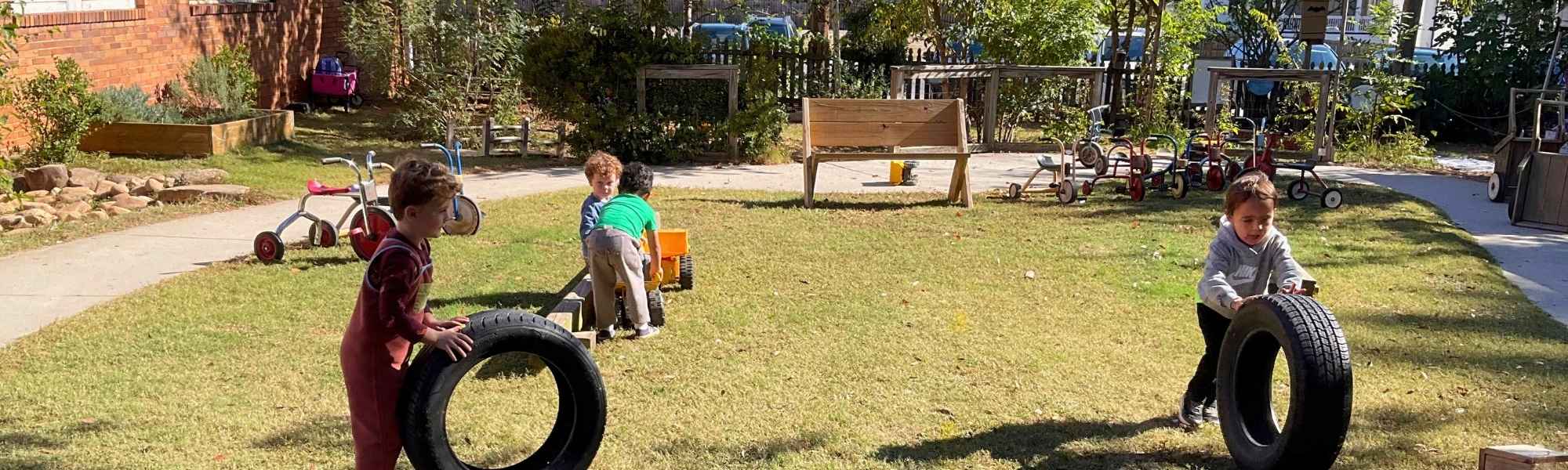
The outdoors is central to OCP’s curriculum.
The children spend a significant amount of their time outside in the Mark Treadwell Play Garden, named for a beloved member of the OCP community.
It was designed by a landscape architect–with extensive input from parents, alumni, and staff–to create an environment in which children can explore a natural space guided only by their imagination.
We wanted to provide natural spaces where children can be creative and really explore with their imagination, and with each other.
The garden includes tree stumps for sitting and storytelling, vegetable gardens, a composting area, a sand pit, an art wall, a music garden with outdoor drums and xylophones and an “exploratory garden,” where children can explore plants and wildlife with their senses. Instead of traditional playground equipment, the playscape provides tree trunks for climbing, swing hammock, a slide and tunnel built directly into a small hill. A central grass area is surrounded by a looping, curving sidewalk track for tricycle riders.
We are committed to a Green Curriculum.
We lead the children by example and teach tangible practices for living more sustainably to help develop a lifetime of wonder and respect for the natural world. Even preschoolers are able to develop a care for the environment that we hope will stay with them for a lifetime. As children deepen their connection with nature, they develop empathy, learn about science, and become eager and thinking caretakers of our earth.

Community and diversity.
We help children develop positive self-identity and respect for–and celebration of–differences by using materials that represent and draw from a variety of cultures, ethnicities, family structures, and equally represent both genders.
We want children to feel proud of themselves, their families, and their communities, and to appreciate and value diversity. We allow children to notice and discuss differences and help them understand their meaning.
